
The Computing Field
2015 • V • 28
The field of Computing—in some countries more commonly referred to as Informatics
However, Computing is far from monolithic. While a shared foundation exists, it is possible to identify distinct emphases and approaches within the field. Naturally, newcomers are not expected to fully grasp these nuances. In some cases, even those with experience in the field may lack awareness ot its internal diversity.
In 2014, I encountered prima facie evidence that even senior individuals—both in academia and industry—often failed to recognize the distinctions within Computing, and perhaps were unaware of them altogether. In certain contexts, this lack of differentiation hinders dialogue, delays mutual understanding, and contributes to setbacks, including the underrecognition of specific competencies and areas of interest. While I can not change this situation single-handedly, I felt compelled to contribute to mitigatting it.
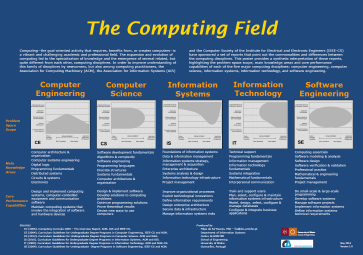
The solution I arrived at was the creation of the poster below. Though it reflects a personal interpretation, it is grounded in the curricula recommendations issued by the Association for Computing Machinery (ACM), IEEE Computer Society (IEEE-CS), and Association for Information Systems (AIS) for the field of Computing.
The poster presents the five main disciplines in the field of Computing—listed alphabetically: Computer Engineering, Computer Science, Information Systems, Information Technology, and Software Engineering. For each discipline, it outlines the specific problem space it addresses, the main knowledge areas it draws upon, and the core performance capabilities that define its professional practice.
The poster is based on the Computing Curricula (2006) and the curricula guidelines for undergraduate programs in Computer Engineering (2004), Computer Science (2013), Information Systems (2010), Information Technology (2008), and Software Engineering (2004).
Click the figure below to download a full-size PDF file of the poster.
UPDATE, 2021 • IV • 3
The poster appears to have proven useful: in late 2020, it was included as Appendix A in the primary curriculum reference for the field of Computing, published jointly by ACM and IEEE-CS.
I originally developed the poster in 2014. Since then, several curriculum guidelines for undergraduate degrees have been updated: Computer Engineering in 2016, Information Systems in 2021, Information Technology in 2017, and Software Engineering in 2015. While these updates introduced changes to the curricula, I believe the foundational distinctions that characterize each of the five original Computing disciplines have largely remained consistent.
In 2021, ACM and IEEE-CS published
This publication brought two noteworthy additions to the dicussion of Computing disciplines: Cybersecurity and Data Science.
Regarding Cybersecurity, ACM, IEEE-CS, AIS Special Interest Group on Information Security and Privacy, and the International Federation for Information Processing (IFIP) Technical Committee on Information Security Education jointly published
As for Data Science, at the time CC2020 was released, curriculum guidelines for undergraduate programs were still under development. These were later published by ACM in 2021 as
Today, Data Science and Information Systems are arguably the two Computing disciplines whose interdisciplinary nature is most evident.
Perhaps one day there will be an updated version of the poster... Until then, let us continue to recognize and appreciate the richness and diversity within the Computing field!
© 2025– Filipe de Sá-Soares. All rights reserved.