
Original source publication: de Moura, F. L., F. de Sá-Soares, H. M. Kubis, I. Kawashita, J. S. Mota and N. Takagi (2021). IT-CMF and BPM Critical Capability: Improving Software Development Lab on Academic Context. Proceedings of the Conference on Enterprise Information Systems 2020—CENTERIS 2020, Vilamoura (Portugal).
The final publication is available here.
IT-CMF and BPM Critical Capability: Improving Software Development Lab on Academic Context
a Instituto Federal Catarinense, Araquari (SC), Brasil
b Universidade do Minho, Guimarães, Portugal
Abstract
In order to generate better results, organizations are required to better manage and develop their processes. The role of Business Process Management (BPM) discipline and the exploitation of the organization’s Information Technology (IT) capabilities are perceived as important instruments to the improvement of business processes. An empirical study was conducted in the Software Development Lab of a Higher Education Institution using the Information Technology Capability Maturity Framework (IT-CMF) to diagnose the current BPM maturity level and to improve its processes. This Software Development Lab bridges the gap between academia and industry, developing students’ skills for the challenges of the workplace. One contribution to the study is a list of applied questions and their relationship with IT-CMF Capability Building Blocks that can serve as a basis for other practitioners. Another contribution is a list of actions to be performed by the Lab senior management to increase the maturity level of the Lab management of business processes.
Keywords: IT-CMF; Business Process Management; BPM; Software Development; Higher Education; Competency; Project Management
1. Introduction
Organizations depend on the existence of processes, as they are the basis of any business, whether they are properly managed or not. Process development may be achieved by standardizing management processes through the adoption of best practices and use of appropriate frameworks and standards [vom Brocke and Rosemann 2019]. Successful process evolution preserves the quality standards of products and services and aggregates value to the organization.
Business Process Management (BPM) is a disciplined approach that aims at the optimization of business processes by applying several techniques and tools. The challenge is to reduce the business processes management waste and foster the technological singularity described by Vinge [Vinge 1993].
In order to assist the Lab’s senior management in developing internal processes, this work applied the practices recommended by the Information Technology Capability Maturity Framework (IT-CMF) [IVI 2016]. IT-CMF is a framework that helps organizations add value through investments in Information Technology (IT). The framework is structured in 36 areas, called Critical Capabilities (CCs), which involve the organization’s Information Systems and Technology (IST) professionals. The option for this framework is justified by the IT environment in which the Lab operates and by the fact that IT-CMF includes a CC specifically dedicated to BPM.
Data collected from top management allowed the assessment of the Lab at a maturity level in the context of BPM. The data was organized according to the diagnostic mechanism proposed by IT-CMF. The findings of the study were presented to the Lab’s management, together with action proposals for the development of the Lab’s processes, involving the adoption of technologies and management tools.
This paper is structured as follows. Section 2 presents the theoretical foundation of the study with a brief review of the fundamental concepts. Section 3 presents the context of the institution and the Software Development Lab, where the research was conducted. Section 4 describes the applied methodology, highlighting the steps applied to the case study. In Section 5, the results with the list of proposed actions are presented. Finally, in Section 6, we draw our conclusions and propose future work.
2. Theoretical Foundation
2.1 Business Processes and Maturity
A business process broad definition can address the what, where, when, why, and how work is done and who is responsible for doing it [ABPMP 2013]. In order to increase the efficiency and effectiveness of the organization, attention must be paid to processes. Their improvement is made possible through process mapping [vom Brocke and Rosemann 2019]. Mapping and making processes available facilitate transparency in activities. It allows identifying those involved in each step, realizing the scope of the process, and finding situations where costs can be reduced.
The Capability Maturity Model Integration (CMMI) [SEI 2010] is a cornerstone of staged maturity models adopted in Software Engineering. The model was originally developed to assess the maturity of software development processes and is based on the concept of immature and mature software organizations [Rosemann and de Bruin 2005]. Another initiative that contemplates the concept of maturity is the Business Process Maturity Model (BPMM), which serves as a mechanism to assess the maturity of processes. BPMM provides guidelines for processes continuous improvement, promoting compliance, and reducing rework [Lee et al. 2007]. In the context of project management maturity, the Project Management Institute (PMI) offers the Organizational Project Management Maturity Model (OPM3) [PMI 2013].
2.2 IT-CMF
Regarding IST maturity models, it is worth noting the relevance of IT-CMF. It provides an integrated approach within 36 different areas of the organization–the CCs–in which IST professionals can operate to add value to the business [IVI 2016]. The framework aims to meet managers’ expectations regarding IST financial investments. The evolution of the organization is described in five levels of maturity, present in each of the CCs, which are grouped into four large groups, called Macro Capabilities. The goal of IT-CMF is to address the challenges faced in optimizing business value through the application of IST [Carcary et al. 2015]. The four main benefits of using IT-CMF are the following: business focused on value, not on cost; IT budget aimed at sustainability; focus on optimized value, instead on the value generated by cost; and IT considered as an organizational core competence [Doherty et al. 2013].
The IT-CMF is frequently updated by the Innovation Value Institute (IVI), so it is kept relevant to the marketplace needs. The advantage of using the IT-CMF refers to what its authors refer to as existing relationships between the CCs, such that improvement actions applied in one CC may benefit other CCs. In essence, IT-CMF presents itself as a holistic framework, which helps Chief-Information Officers and decision-makers improve the maturity of capabilities and direct responsibilities towards the necessary efforts to be made [Carcary et al. 2015]. Each of the CCs has the same structure, being composed of [IVI 2016]:
Overview: provides the contextual background for each CC. It describes the CC goal, objectives, value, and relevance;
Scope: relates to the formal definition of the area and activities that the CC covers;
Interpreting Maturity Levels: assists in the identification of intermediate status, that is, an evolution in progress by the organization;
Practices-Outcomes-Metrics (POMs): suggests best practices for each maturity level of each CC. Practices can be applied to maintain the current maturity level or to evolve to the next level. Each POMs points out the benefits of the practices application and metrics to verify the results of the efforts.
2.3 Business Process Management (BPM) in IT-CMF
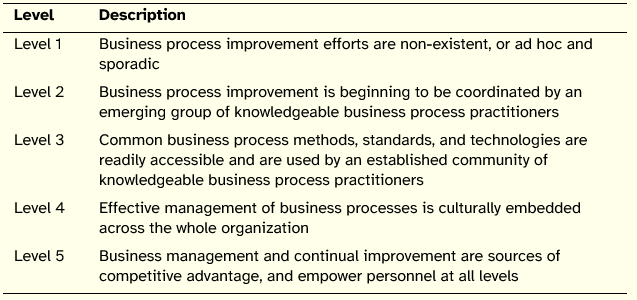
Among the CCs composing IT-CMF is Business Process Management. BPM refers to the ability to perform process documentation and also assist in the execution of new or existing processes [IVI 2016]. It is a management discipline focused on end-to-end processes, including, among others, organizational structures, roles, and policies. It aims to establish the governance of processes, integrating elements in such a way that the organization has a unique view of its internal and external environments and operations. Thus, BPM offers a clear view of the influence of these elements in the organization’s business processes [ABPMP 2013]. BPM includes methods, techniques, and tools to support the design, enactment, management, and analysis of operational business processes [van der Aalst et al. 2003]. IT-CMF defines the BPM CC with five different levels of maturity for business process management. Table 1 presents the maturity levels, with level 5 being the most mature level.
The Capability Building Blocks (CBBs) present in each CC of the IT-CMF are used to classify the organization in one of the maturity levels. They are divided into two categories: Foundation and Implementation. For the case of BPM CC, Foundation is composed of five CBBs that define how to establish BPM and stimulate the development of standards, methods, models, technologies, training, and communication approaches. Implementation has six CBBs associated, which determine and manage how BPM will be put into practice for the organization [IVI 2016]. These CBBs are:
Foundation: (A1) Strategy and Leadership; (A2) Support Organization and Personnel; (A3) Standards and Methods; (A4) Technologies; (A5) Stakeholder Management;
Implementation: (B1) Scope of Implementation; (B2) Process Architecture; (B3) Process Governance; (B4) Process Improvement; (B5) Process Automation; (B6) The IT Contribution.
IT-CMF proposes two means to assess the maturity level. The more detailed is related to each CBB and offers a general classification, which positions the organization at a maturity level in a CC. After the diagnosis of the maturity level, the IT-CMF provides guidance on the necessary actions to reach the next maturity level using POMs.
Table 1: Maturity levels—BPM Critical Capability
Source: [IVI 2016]
3. Scenario
This study was conducted in the Software Development Lab of a Higher Education Institution that has 15 campuses. The selected campus has approximately 2,000 students. The programs in the technology area involve approximately 450 students, divided into two higher education programs and one professional program. The Software Development Lab was created in 2014. One of its objectives is to allow students to experience the software development process, from requirements gathering to the delivery of the final product, through the execution of related activities of research and extension projects. Another objective is to create and maintain partnerships with private and public companies to foster regional development. The Software Development Lab is not for profit. In practice, the goal is to take the student closer to the daily lives of IST professionals. Through partnerships, it aims to create a greater commitment to deliver on deadlines, solve problems, manage demands, promote leadership, and manage human and technological resources. The Software Development Lab has already delivered several solutions, both in terms of computer applications and data analysis for public and private initiatives. More than 200 students have participated in the Lab’s projects, and the feedback from the companies that hired these students is positive. The Lab is a successful case for the region and encourages the execution of research works like this one.
The Software Development Lab acknowledges that several processes could be improved. For example, some important processes lack documentation. The evolution of process management could facilitate communication among Lab’s members and improve the understanding of the Lab operation by new teachers and students. It would also provide new ways of measuring the work done by the Lab. Since the control mechanisms are informal, measuring the quality of work is a challenge. As the transparency of the Software Development Lab processes improves, it will be possible to define better performance indicators, as well as to increase results’ efficiency and effectiveness.
The IT-CMF framework aims to add value to the business through the correct use of the available IST, making the adoption of the framework appropriate to the present case, especially with regard to the BPM CC. The next section describes how the framework was applied in this study.
4. Research Design
This work is categorized as a case study, involving the identification of the maturity level of the Software Development Lab, according to the haracteristics present in the maturity model for BPM proposed by IT-CMF. A case study is defined as an empirical analysis that studies a fact and its circumstances [Yin 2003]. It is one of the most used methods in the area of Information Systems for studies with a qualitative approach, which may involve an individual, a group of people, or an organization [Myers and Avison 2002]. This work adopts Yin’s [2003] approach, and is within what the author characterizes as a descriptive study. Stages with details about the actions performed are described below.
Planning: understand the definition of the method to be used at work, considering the method’s strengths and weaknesses. Therefore, the possibility of developing a descriptive case study using interviews was identified;
Conception: list the possible case studies, as well as the procedures to be performed. At this time, the objectives of the study and the stages for its execution were defined and scheduled;
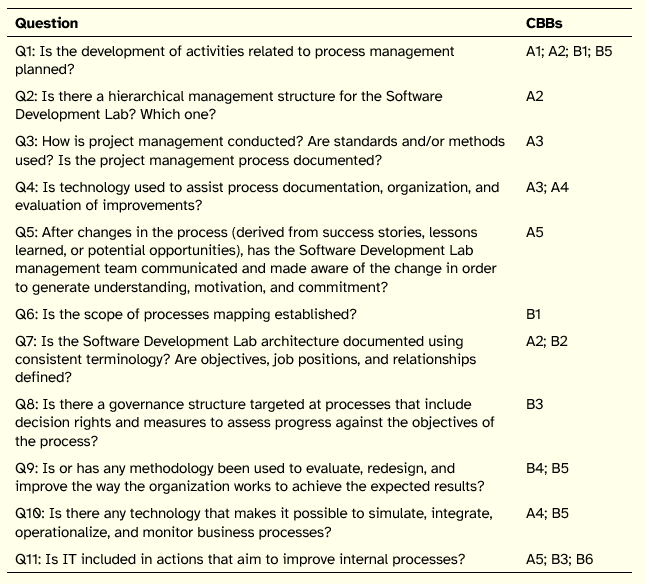
Collection: set the data collection process. For this study, a semi-structured interview was conducted with the Software Development Lab coordinator. The interview contained 11 questions. Each question was related to one or more CBBs;
Analysis: analysis of data and validation of the theories that comprise the study. The data collected in the interview were compiled according to the IT-CMF maturity model for BPM to classify the Software Development Lab into a maturity level;
Disclosure: presentation of results to the study interested parties. Indications that allow the target audience to reach their conclusions on the subject should be provided. Before making results public, there was a presentation to the Software Development Lab senior management. It served to check both the classification of the maturity level, as well as the feasibility of carrying out improvement actions, according to IT-CMF framework guidelines.
Table 2 presents the questions developed for the interview conducted at the Software Development Lab. For each question, related CBBs are listed in the second column.
Table 2: Interview Questions and Related CBBs
5. Results
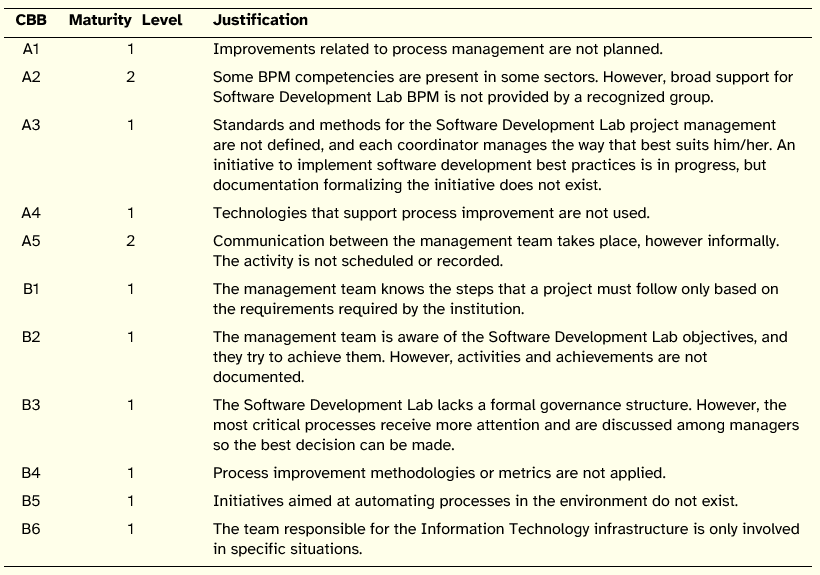
5.1 The Software Development Lab BPM Level of Maturity
Table 3: CBBs Maturity Levels and Justifications
5.2 The Software Development Lab BPM Improvement Plan
The assessment of the Lab’s BPM maturity level was based on the characteristics of each maturity level presented in the IT-CMF framework BPM CC. The results placed the Software Development Lab at Level 1. The adoption of the POMs [IVI 2016] as guidelines to raise the maturity level of the Lab environment led to the proposal of three actions to the management team:
Action 1: Evaluate appropriate BPM technologies for the organization. Following this guidance, several solutionswere identified. One of the technologies recommended is draw.io, which is a drawing tool. It allows building process mapping collaboratively and is integrated with Google service. As the institution has access to Google Drive services, draw.io is a suitable option. This tool offers support to several BPM notations, facilitating the creation of flowcharts. The expected results are the increase of requests to use the technology adopted to support process mapping, and the metric to indicate the proposal’s success is the increase of initiatives in this area;
Action 2: Define owners of the highest priority processes. The proposal points to the need to identify those responsible for the processes, as they are responsible for executing and improving their processes. However, Action 2 is conditioned by the results of Action 1, since it is necessary to map processes to subsequently assign the responsibilities of each member of the Software Development Lab. The recommendation is the use of the RACI matrix (Responsible; Accountable; Consulted; Informed), which provides transparency in the involvement of each person with the processes executed in the studied environment. The RACI matrix must be available to all Lab members. By building a RACI matrix, the Lab may clarify the understanding of process roles and responsibilities, define key people for the processes, and improve internal communication. The expected result of this proposal implementation refers to the increased responsibility for the management of the most critical processes, to be measured by the percentage of critical business processes with defined owners.
Action 3: Establish a process improvement practice, such as Lean, Six Sigma, or Total Quality Management. The mapping and prioritization of processes should be done first, to facilitate the achievement of possible improvements in the identified processes. One option is to adopt the practices proposed by the PDCA cycle (Plan-Do-Check-Act) to support the diagnosis of problems at the Software Development Lab, and also to obtain greater control of the processes on an ongoing basis. It is worth noting that this practice has no end and implements the expected continuous improvement processes at the Lab. The application of a continuous improvement methodology is supposed to increase the organization’s effectiveness and performance. It is measured through the added value to process improvement projects.
5.3 Typical Challenges
Typical challenges refer to the possible barriers that the organization may face when implementing the proposed improvements. Some of these challenges are foreseen in the IT-CMF framework and maybe of cultural or financial natures. IT-CMF recommends specific actions to overcome the anticipated challenges.
5.4 Presentation of the Proposed Improvements
After establishing the maturity level and defining the improvement proposals for the environment, findings were presented to the Software Development Lab’s management team. Their feedback was instrumental in validating the applicability of IT-CMF. In the presentation, the concepts highlighted in the literature review were introduced with emphasis on the IT-CMF framework BPM CC. The data collection mechanism was also presented to senior management. They agreed with the collection process and with the classification of the Software Development Lab maturity level in the context of BPM, according to IT-CMF.
Improvement actions were also presented. The feedback on Action 1 relates to the difficulty of understanding the concept of process management performed by students since the Lab customer does not require or pay for it. An existing process was used as an example. It also served to demonstrate how its management and improvement can contribute to students’ academic experience and the acquisition of specific knowledge and skills. To clarify the concept of process management, a model to guide the initiation of the work was requested. Action 2, related to the use of the RACI matrix, obtained greater acceptance. No objections or clauses were presented. However, to complement the process-mapping model, guidelines for using the RACI matrix were produced. In the presentation, the importance of developing proper documentation was stressed. Documents include the diagrams, responsibility matrices, documents resulting from the process execution, among others. They serve to keep the history of the records used in the environment and can be accessed later. Improvement Action 3 received no comments. In any case, this practice must be established in the Software Development Lab environment.
In addition to validating the applicability of IT-CMF in the environment, it is noteworthy that the members of the management team also stressed the relevance of BPM activities, especially at a time when the Software Development Lab may be replicated on other campuses, serving as a model for the new environments.
6. Conclusions and Future Works
Young organizations, such as the Software Development Lab, or those going through a crisis or changes, usually have difficulty prioritizing processes and changes necessary for improvements in the medium or long terms. A sound approach is to start with improvements that deliver quick and visible results, so those involved gradually become more committed. The difficulty may originate in the culture established in the organization, which sometimes limits the identification of new opportunities and, consequently, its growth. This difficulty was identified in the Software Development Lab, concerning the implementation of changes, coming from both people and processes.
The presentation to senior management aimed to make them aware of the importance of managing Lab’s processes. It was identified that there is no understanding of exactly how to approach the concept of process at the Lab since it is part of an academic environment. Later, an example of what would be a process to be adopted in the academic environment was developed, both to assist in the management and to enable gains at the pedagogical level. This process strengthens the Software Development Lab objective related to the immersion of students in an environment that simulates practices and challenges that will be experienced in their professional lives.
In general, the improvement proposals were well received. Moreover, the organization could resort to the practices proposed by the IT-CMF framework. It contemplates several practices to be adopted by organizations, in order to take greater advantage of the use of their IST and to help implement the improvements. The relevance of IT-CMF is demonstrated by the fact that, in 2010, the framework already accounted for more than 10 million dollars in human resources involved, in its more than 60 thousand hours of work [Costello 2010]. Other actions to be developed in the Software Development Lab may add even more value to the its members, since there is the possibility of replicating the environment in other campuses, as well as the development of higher quality products and services in the various projects involving partnerships with public and private institutions.
The continuity of this work under the guidance of IT-CMF in the Lab context is considered of high relevance, as it intends to raise the environment’s BPM maturity level, especially now that the Software Development Lab is going through a moment of expansion. IT-CMF indicates that other CCs may be influenced by improvements resulting from the actions mentioned in this work. The affected CCs are Business Planning (BP), Risk Management (RM), Service Analytics and Intelligence (SAI), and Enterprise Architecture Management (EAM). Working on the practices associated to the CCs mentioned above will allow both higher consistency in the processes of the organization and increased confidence in the framework as a resource to be used in an academic context. This study established the feasibility of applying IT-CMF in an academic environment. Therefore, the framework could be used by practitioners to develop other case studies in the Lab. Moreover, IT-CMF could be incorporated as a supplemental reference in academic and professional programs related to the Lab.
References
van der Aalst, W. M. P., A. H. M. ter Hofstede and M. Weske (2003). Business Process Management: A Survey. Business Process Management, 1–12. Heidelberg: Springer.
ABPMP (2013). BPM CBOK (Guide to the Business Process Management Body of Knowledge). Association of Business Process Management Professionals.
vom Brocke, J. and M. Rosemann (2010). Handbook on Business Process Management 1. Heidelberg: Springer.
Carcary, M., E. Doherty and C. Thornley (2015). Business Innovation and Differentiation: Maturing the IT Capability. IT Professional 17(2), 46-53.
Costello, T. (2010). A New Management Framework for IT. IT Professional 12(6), 61–64.
Doherty, E., M. Carcary, U. Downey and S. McLaughlin (2013). Enhancing IT Capability Maturity—Development of an SME Framework to Maximize the Value Gained from IT. Innovation Value Institute.
IVI (2016). IT Capability Maturity Framework (IT-CMF)—The Body of Knowledge Guide. Maynooth: Innovation Value Institute.
Lee, J., D. Lee and S. Kang (2007). An Overview of the Business Process Maturity Model (BPMM). In Advances in Web and Network Technologies, and Information Management, 384–395. Heidelberg: Springer.
Myers, M. D. D. and Avison (2002). Qualitative Research in Information Systems: A Reader. London: SAGE Publications.
PMI (2013). Organizational Project Management Maturity Model (OPM3), third edition. Newtown Square, Pa.: Project Management Institute.
Rosemann, M. and T. de Bruin (2005). Towards a business process management maturity model. ECIS 2005 Proceedings.
SEI (2010). CMMI for Development (CMMI-DEV) V1.3. Software Engineering Institute. Massachusets.
Vinge, V. (1993). The Coming Technological Singularity. VISION-21 Symposium. NASA Lewis Research Center and the Ohio Aerospace Institute, Washington, DC.
Yin, R. K. (2003). Case Study Research: Design and Methods, third edition. Thousand Oaks: SAGE.