
Original source publication: Capeça, G. e F. de Sá-Soares (2015). Auditoria do Alinhamento entre Sistemas de Informação e o Negócio. Actas da 15.ª Conferência da Associação Portuguesa de Sistemas de Informação—CAPSI 2015. Lisboa (Portugal).
Information Systems and Business Alignment Audit
Center ALGORITMI, University of Minho, Portugal
Note: Paper translated from Portuguese to English.
Abstract
The application of information technology in organizations has given rise to concerns about the real value of these technologies in supporting the business, leading to the problem of alignment between the organization’s information system and the organization’s business taking on a prominent role both in academia and in professional practice.
For organizations to achieve alignment between the application of information technology and business objectives and strategy, they need to address and articulate aspects such as business strategy, information system strategy and technological and organizational infrastructures.
We argue that information systems governance and information systems management are necessary preconditions for the pursuit of alignment. In order to examine these preconditions, this study proposes an audit procedure based on COBIT 5, which was applied in the preliminary assessment of the support provided by information technology to the organizational activities of a central bank.
Keywords: Alignment; Information Systems Governance; Information Systems Management; Auditing; Information Technology
1. Introduction
Information systems (IS) are now crucial tools for the success of organizations. As the use of information technology (IT) intensifies, as organizations compare themselves in terms of performance and as IT efforts and investments come under greater scrutiny, the concern to ensure that the application of IT is aligned with the organization’s business becomes increasingly relevant.
In order for organizations to achieve alignment between IS and the business, they have to articulate aspects such as the business strategy, the IS strategy and the technological and organizational infrastructures [Croateau and Begeron 2001]. Although there are many studies in the literature that reveal the centrality of alignment for organizations (cf. [Chan et al. 2006], [Kappelman et al. 2013] and [Luftman and Derksen 2012]) and point to critical factors for achieving it (cf. [Campbell et al. 2005] and [Teo and Ang 1999]), there are also different proposals for assessing the alignment between IS and the business of organizations, with different emphases and varied methodological approaches (cf. [Belfo and Sousa 2012], [Chan and Reich 2007], [Kearns and Lederer 2003], [Sabherwal and Chan 2001] and [Tan and Gallupe 2006]).
Given that the pursuit of alignment requires a continuous process of adjustments between the business and the application of IT, embodied in dialogues, negotiations and decisions between agents from the business areas and agents from the IS area (IS function), we argue that the activities of IS governance and IS management are preconditions for the pursuit of alignment by organizations. Consequently, assessing the degree of alignment will initially involve assessing the quality of these two activities. The formalization of this assessment could take the form of an audit.
This paper outlines an audit procedure that aims to evaluate IS governance and management activities from the perspective of alignment between the application of IT and the organization’s business.
Methodologically, this procedure was outlined through a case study carried out in a central banking institution. Structurally, the work is organized as follows: after this introduction, the concept of alignment is reviewed, governance and information systems management activities are put into perspective, followed by a description of the study carried out. Subsequently, the results of the study are presented, the recommendations derived are listed and a set of final considerations is presented.
2. Alignment between Information System and Business
The alignment between the information system and the business is one of the recurring themes in the information systems literature. Since the emergence of interest in this subject, precipitated by the recognition that many organizations made when they realized that they were not developing information systems that supported their business strategies, several authors have looked at this issue, accompanied by continued interest on the part of IS managers who, year after year, point to the search for alignment between the application of IT and the business as one of their central concerns (cf. [Kappelman et al. 2014]).
Confronted with failures to obtain business benefits from the application of IT and the business and technological risks that organizations face, the search for alignment between the information system and the business is a defense mechanism for the organization itself, i.e. it is believed that greater and better IT support for the business will boost more robust organizational performance, which will strengthen the organization’s competitive position in the market. This will lead the organization to achieve successive, albeit temporary, balances between its internal environment and its surroundings.
To achieve this state of convergence between IT and the business, it is natural for organizations to pursue greater integration between specific processes in each of the two domains involved - the information system and the business, for example by intensifying integration between the IS planning process and the organization’s strategic governance process [Pitassi and Leitão 2002, p. 79] or by converging the IS function’s actions with the strategic interests of the entire organization [Calle Jr. and Kanter 1998, p. 1].
The search for alignment between the information system and the business is based on a management process involving the various business units, guided by the organization’s objectives. This process rests upon the formulation of objectives and the implementation of actions that result in greater or better IT support for the business. To do this, it is necessary to take into account factors external to the organization, imposed on it by its environment, and factors internal to the organization. The factors that condition the success of the organization in achieving alignment include human, informational and organizational capital, using the categorization proposed by Kaplan and Norton [2006]. The human capital category includes aspects relating to the talent, qualifications, experience and knowledge of the organization’s employees, as agents in the alignment process. The information capital category includes aspects related to IT infrastructures, IT platforms, computer applications and information, as structural limiters and enhancers of the information system in the alignment process. Finally, the organizational capital category includes aspects relating to organizational culture and leadership, as structural limiters and enablers of the business in the alignment process.
Alignment between the information system and the business can be understood as the harmonious application of IT with the strategy, objectives and needs of the business, in an appropriate and timely manner. In order to achieve alignment between the application of IT and the business, the organization will engage in a continuous process of adjustments with the aim of achieving interconnection between the business objectives and strategies and the IS objectives and strategies [Affeldt and Vanti 2009].
It should be noted, however, that it is not enough for the application of IT to be aligned with the business, it is important for the business to understand the importance and usefulness of IT in supporting the achievement of its objectives. In fact, this is a distinction in terms of what could be called the degree of quality of alignment: an organization can apply its IT perfectly in line with its business, but at the same time underuse the potential of IT to support business strategy and processes.
Alignment has emerged as a key factor for the success of organizations in a highly dynamic environment, as IT must enable them to do the right thing (effectiveness) and in the best possible way (efficiency) [Luftman 2000]. In order to achieve this alignment, Henderson and Venkatraman [1993] proposed a model for adjusting four fundamental aspects: business strategy, IT strategy, organizational infrastructure and processes and IT infrastructure and processes.
Business strategy involves a moment of formulation (choice of competitive approach, products and markets) and a moment of implementation (decisions about the structure and capabilities that will execute those choices). Similarly, IT strategy must involve choices about the types of information technology to employ and their means of use and acquisition (formulation) and decisions about how the IT infrastructure should be configured and managed (implementation).
These four aspects are aligned along two dimensions, as shown in Figure 1:
Strategic Adjustment - between the internal and external domains.
Functional Integration - between the business and information systems domains.
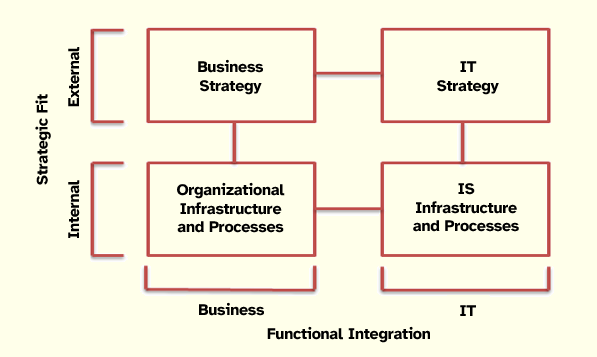
Figure 1: Henderson and Venkatraman [1993] Alignment Model
As already noted, alignment between the application of IT and the business is not an event, but a continuous process of adaptation and transformation [Henderson and Venkatraman 1993]. Achieving it requires a change, often substantial, in management thinking about the role of IT in the organization, as well as an understanding of IS strategy and its importance in both supporting and driving business strategy decisions.
If we look at the interrelationships between the business and the information system, in terms of their strategies, processes, resources and agents, in order to achieve the much sought-after alignment between the information system and the business, then we can consider that the governance of the organization’s information system is a fundamental prerequisite for the success of any initiatives aimed at improving that convergence between IT and the business. As the search for this convergence is an ongoing process, then it is equally possible to argue about the importance of information systems management in achieving alignment, which is always imperfect and unfinished.
3. Information Systems Governance and Management
Information systems governance is a relatively recent concept in the literature, but one that is gaining relevance both in academia and among professionals. Faced with the potential application of IT in all or almost all organizational areas and the transformation of the role of IT from mere administrative tools to strategic instruments [Henderson and Vankatraman 1993], many companies and government agencies have moved towards the implementation of IS governance in order to achieve the fusion between business and IT and obtain the involvement of senior management in IS issues [Haes and Van Grembergen 2009].
Although organizations manage many assets (people, money, facilities, etc.), perhaps information and the technologies that collect, store, process and disseminate it are among the assets that cause them the most perplexity and pose the greatest challenges. If, on the one hand, businesses demand ever more rapid change, systems, once implemented, remain relatively rigid. Often, IT implementations involve immediate and ongoing investments, in pursuit of results that can be difficult to predict and realization not always satisfactory. These uncertainties and complexities cause many managers to abdicate responsibility for ensuring that the organization’s employees use IT effectively [Weill and Ross 2004].
The adoption of IT in the organization is recognized as a complex process that involves planning, evaluating the cost/benefit generated by the system and adapting it to the organizational reality. In fact, this adoption is a process of change that encompasses not only the technological environment, but also the technical environment, human resources and the entire structure of the organization [Pascutti et al. 2009].
Ultimately, IS governance is the responsibility of the organization’s executive team, and responsibilities for this activity are often assigned to a committee made up of top, line and IS executives, in order to bring together the different perspectives and sensitivities held by the business and IT players.
IS governance provides leadership, organizational structure and process orientation to ensure that the organization’s IS function understands and supports the organization’s strategies and objectives. The importance of this activity thus derives from the way it deals with the main business issues and their relationship with information systems, the protection of strategic information systems and the guidelines it establishes for the IS management activity [Buckby et al. 2005].
It is important to emphasize the distinction between the IS governance activity and the IS management activity, as we sometimes come across visions in which these two activities are understood as synonymous or, in the incessant search for the new buzzword, the governance activity is presented as the new formula which, by enhancing the benefits and eliminating the difficulties of the management activity, will solve all the problems faced by IS managers.
While IS management focuses on the efficient and effective delivery of IS services and products and the management of IS operations, IS governance faces the dual demands of contributing to current business operations and performance and transforming and positioning IT to meet future business challenges [Peterson 2003].
This differentiation between IS governance and IS management has been explicitly recognized by the most recent version of the COBIT benchmark (COBIT 5), in which IS governance ensures that the needs, conditions and options of stakeholders are analyzed to formulate balanced and agreed objectives to be achieved, setting direction through prioritization and decision-making [ISACA 2012]. In addition, governance also ensures the monitoring and compliance of the direction and objectives previously established. In turn, IS management is responsible for planning and executing IT-related initiatives, aligning them according to the directives received.
This distinction between IS governance and management is directly reflected in the model proposed by COBIT, which subdivides IT-related practices and activities into two main domains, with governance associated with the analysis, direction and monitoring of initiatives related to information systems, and management associated with the planning, construction, execution and monitoring of the information systems themselves, as illustrated in Figure 2.
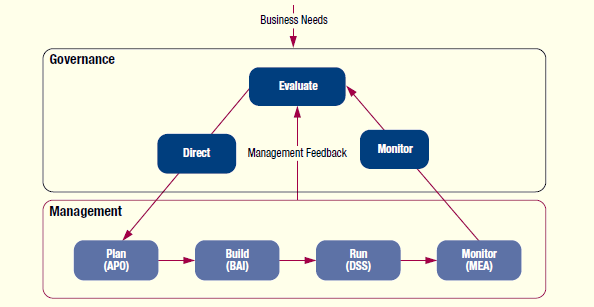
Figure 2: Relationship between COBIT 5 Domains
Adapted from ISACA [2012, p. 32]
IS governance is based on a structure of relationships and processes to direct and control IT in order to achieve the organization’s goals by adding value. To this end, IS governance aims to answer the following questions [Weil and Ross 2004]:
Do IT capabilities improve the organization’s competitiveness?
Do all managers in the organization recognize their responsibilities for the effective management and use of IT, or do they assume that this is only an IS problem?
Do IT investments in the organization aim to meet strategic objectives or does the organization waste resources and investments by only meeting tactical initiatives and operational needs?
Since IS governance aims to know the value and strategic importance of IT in the organization, to ensure that IT can support its operations and to ensure that it can implement the necessary strategies in the face of the organization’s future growth and expansion, IS governance best practices should ensure that IT expectations are met and the risks inherent to IT are minimized [ISACA 2012].
In this way, the effective use of IT and the integration between its strategy and the business strategy go beyond the idea of IT as simple tools for process automation and productivity. The path to the successful application of IT in the organization is no longer related solely to the hardware and software used, or to the IS development methods adopted, but to the degree to which the application of IT is aligned with the strategy and characteristics of the organization and its organizational structure [Laurindo et al. 2001, p. 161].
Although the importance of alignment between the application of IT and the business is widely recognized both in the literature and in IS practice, assessing how well an organization pursues or achieves this alignment raises interesting challenges. The assumptions made in this paper are that good IS governance, together with good IS management, are necessary conditions for achieving alignment between the information system and the business. It is therefore argued that the first step in gauging the degree of alignment is to evaluate the two activities related to the information system - governance and management. If it is found that these activities are of sufficient quality, then attention can be focused on the procedure for measuring the specific degree of alignment and, at the same time, the aspects that need to be improved in order to intensify the convergence between the application of IT and the business can be pointed out. If these two activities are found to be lacking in quality, then the search for alignment will require a prior review and readjustment of these activities.
Based on the above, the aim of this work was to outline an audit procedure (as a formal, independent and sustained evaluation process) based on the evaluation of IS governance and management activities as a prior step to assessing the degree of alignment between an organization’s information system and its business.
4. Study Description
In order to propose and experiment with the auditing procedure for IS governance and management activities, the case study research method was used. The unit of analysis was a central bank, which, for confidentiality reasons, will be referred to in this study as NSC.
The NSC is the central bank of a country located in Africa. Its organizational structure consists of a Board of Directors, six business units and six support units, including the Information Systems and Technology Department (ISTD). ISTD is responsible for proposing and promoting policies and solutions in the field of Information Systems and Technology to support the Bank’s activity, efficiently providing services for the design, implementation, operation and maintenance of the infrastructures inherent to them.
The NSC, as a central bank, is responsible for regulating and supervising financial institutions in its country. As a regulatory and supervisory bank, and since the number of financial institutions in the country has grown in recent years, to fulfill its role effectively, and since there has been a great deal of investment in terms of IT by those institutions, there has been a need for the NSC also to invest in IT. Thus, in recent years, at the direction of the Central Government, the NSC has invested heavily in IT in order to make its business operations more effective, secure and faster, to strengthen its role as supervisor of the Financial System and to modernize its administration.
To this end, in order to assess whether the investments made in IT are supporting its objectives, i.e., to ensure that IT is being applied in such a way as to support the organization’s objectives, the NSC’s Board of Directors decided to carry out an audit of its information systems. It was within the scope of this audit that this study was carried out and in which a procedure was designed and applied to assess the preconditions for alignment between the application of IT and the NSC’s operations (business). To ensure that IT has been designed and is being applied to support the organization’s objectives, the audit set out to verify the following conditions at the NSC Bank:
Existence of a structure responsible for IS governance and
Existence of a structure responsible for the IS function in the organization, i.e., for the IS management.
In order to carry out the work, it was decided to use COBIT 5 as a benchmark for good IS governance and management practices. To do this, a questionnaire was drawn up with closed questions, where the respondents had to answer only Yes or No (Y/N) according to the questions asked, which was sent to managers in the organization, both in the business and IS areas. Before the questionnaire was sent to the respondents, it was pre-validated by a group of specialists in Information Systems and Technology Auditing to make sure that the questions were clear and relevant, and after some changes and improvements, the group of specialists gave a favorable opinion.
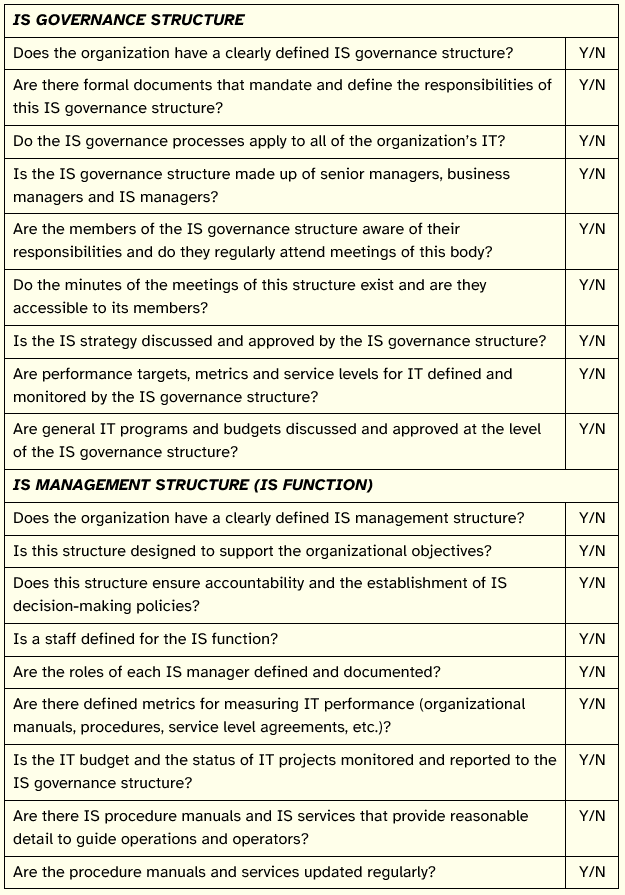
The themes of the questions included in the questionnaire, formulated based on COBIT 5, are those that the IS governance structure is responsible for ensuring and those that IS management is responsible for promoting, as shown in Table 1.
Table 1: Anchor Questions on IS Governance and Management
Adapted from ISACA[2012]
At the start of the work, a formal meeting was held with staff from the organization to gauge their knowledge of the IS needs for carrying out their operational activities. For the IS area, the first meeting was held with the aim of understanding the structure and functions of ISTD. A number of questions were asked, such as: how the department is organized (i.e. how many areas, how many people, who it reports to), what objectives (strategic and operational) have been set for the department, what are the main risks associated with achieving the set objectives, what are the main reports it uses to analyze the progress of the activity/business in relation to the set objectives, what are the key processes of the ISTD and what entities does the ISTD depend on to ensure its objectives.
For the business areas, the questions asked were aimed at ascertaining the main information systems and technology that support their activities, how ISTD has responded to the areas’ information systems and technology needs, among other issues.
At the same time, in the field we checked, based on the documentary reports that ISTD has drawn up and sent to the Chairman of the Board of Directors, the minutes of internal meetings in the area, the procedures and organization manuals and substantive tests, whether the IS governance and management practices at NSC were in line with the good practices recommended by COBIT 5. The substantive tests were carried out to assess whether the processes and procedures for carrying out activities were designed to prevent or detect material errors on a regular basis.
Observation, semi-structured interviews and document collection were used to collect the data.
5. Results
According to COBIT 5, IS governance ensures that the needs, conditions and options of stakeholders are analyzed to determine balanced and agreed objectives to be achieved, setting direction through prioritization and decision-making.
The IS governance structure should be made up of executives, key business managers and the ISTD management team, which should meet regularly to review IT initiatives and projects and prioritize, align and reconcile these projects with the NSC’s business plans and strategic orientation.
The IS governance structure should also be responsible for ensuring that IT performance is in line with business expectations, with Service Level Agreements (SLA’s) providing a basis for the levels and results expected from IT services.
IS management, in turn, plans, creates, executes and monitors IT activities in line with the direction set by the Board and emanating from IS governance to achieve organizational objectives [ISACA 2012].
Thus, the organization should clearly define an IS governance structure, formally mandating and defining its responsibilities. In turn, this structure should ensure that:
IS governance processes apply to all of the organization’s IT;
It includes senior managers, business managers and IS managers;
Its members are aware of their responsibilities and regularly attend the body’s meetings;
The minutes of the meetings of this structure exist and are accessible to its members;
Within this framework, strategic alternatives for the information system are discussed and then the IS strategy is formulated and approved;
Following its strategic determinations for the information system, define and monitor performance targets and high-level metrics, as well as benchmarks for the service levels to be observed by the IT applied;
Also in conjunction with the strategic definition, establish the general programs and budgets for the IS function and, at the same time, for the organization’s IT.
Having completed the work it set out to do, the audit did not identify the formal and structured involvement of the business areas in IS governance. The audit found that there is no IS governance structure in place. The IS function reports directly to the Chairman of the Board of Directors. He in turn presents IT issues to the Board of Directors.
The structured involvement of the business areas in defining the IS strategy, prioritizing business projects and monitoring and evaluating IT service levels was also not identified.
The audit found no evidence of any other formal and regular meetings to discuss IS strategy and business needs involving the bank’s business areas.
Similarly, the audit did not identify regular formal meetings held between the business areas and the IS management team to discuss business needs, and there was no formal process in place to involve the ISTD when projects with IT components were initiated.
IS management is responsible for planning and executing IS initiatives, aligning them with the guidelines received. Hence, the IS function should:
Be designed to support organizational objectives;
Ensure accountability and the establishment of decision-making policies;
Have a perfectly defined staff;
Ensure that the functions of each IS manager are defined and documented;
Ensure the existence of metrics to measure IT performance (organizational manuals, procedures, service level agreements, etc.);
Monitor and report on the execution of their budget and the status of IT projects to the IS governance structure;
Ensure the existence of IS procedures and service manuals that guide operations and operators related to the information system;
Ensure that procedures and service manuals are regularly reviewed and updated.
With regard to the IS function, although there was no formal IS governance structure, it could be seen that the IS function at NSC is formally constituted and documented. Specifically, evidence was found of the formal definition of IS personnel and the processes related to the IS function, as well as the assignment of responsibilities, roles and relationships within the IS function. Information circulation, dissemination and access policies have also been defined, approved by the Board of Directors and disseminated throughout the organization.
The audit noted that policies and procedure manuals were not documented for some IS services. IS-related tasks were carried out based on staff knowledge and experience, without guidance from procedure manuals or policies, thus creating an over-reliance on staff with detailed knowledge of these processes. In the event of a departure or absence of key personnel, there was no documented guidance on how functions should be carried out.
It was also found that no SLAs have been defined between the ISTD and the business areas and there was no accountability indicators reported and controlled on a regular basis. For some IT functions and services, there were no procedure manuals to provide guidance for operations and operators.
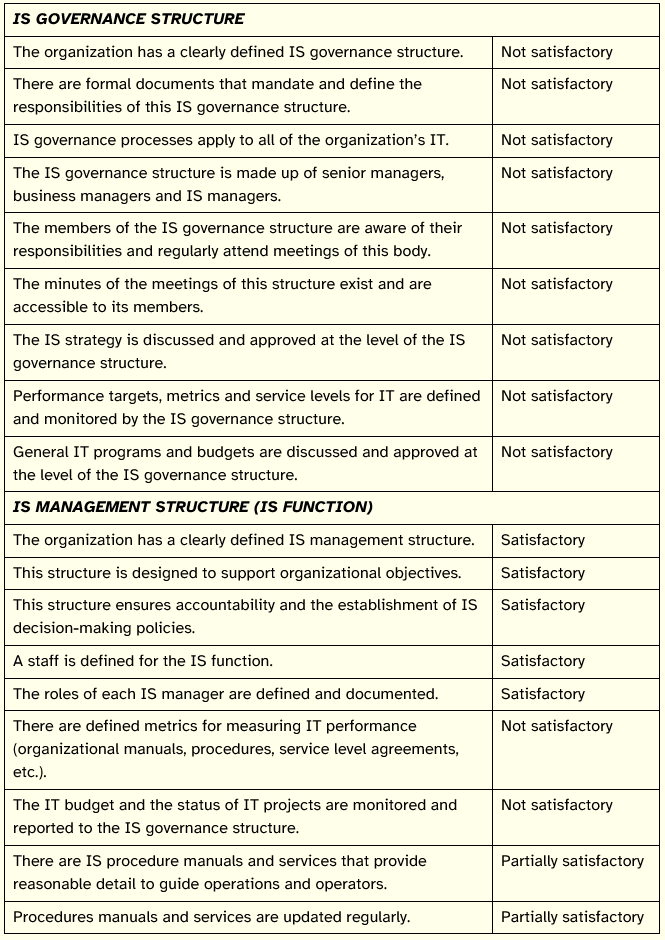
As a summary, Table 2 shows the consolidated positions on the themes underlying the anchor questions previously presented for the NSC bank, indicating the degree of satisfaction on the part of the institution in the areas of IS governance and management examined.
Table 2: Summary of NSC Bank’s IS Governance and Management Assessment
6. Recommendations
IT can make a significant contribution to organizations achieving their objectives, but this requires making IS governance more agile and clear in its implantation and use, especially with regard to aspects such as balancing risks; controlling costs, people, contracts and the provision of third-party services; as well as being clear about how decisions are made and who makes them [Mendonça et al 2013], making it clear that there is an alignment between IT and the business of organizations.
In order to overcome the non-conformities found in the audit carried out at NSC and to improve the alignment between the information system and the Bank’s business, based on the evaluation procedure carried out, the following recommendations have been put forward, in the form of tasks that the institution should carry out in the near future:
Clearly define the IS governance structure;
Drawing up and disseminating the formal documents that mandate and define the responsibilities of the IS governance structure;
Create IS governance processes and apply them to all of the organization’s IT;
Discuss and approve the IS strategy at the level of the IS governance structure;
Discuss and approve IT programs and budgets at the level of the IS governance structure;
Establish metrics to measure IT performance;
Define and monitor IT performance targets, metrics and service levels;
Monitoring and reporting on budget execution and project status to the IS governance structure by the IS management structure.
7. Final Considerations
The subject of alignment between IS and the business of organizations has been studied by various authors. Theoretical and empirical evidence suggests that better alignment between the information system and the business leads to higher levels of organizational performance. In addition, alignment provides visualization of strategic information, as well as positioning the IS area and information systems as key elements in organizations [Affeldt and Vanti 2009].
To ensure that IT are designed to support the organization’s objectives, it is important that there is a commitment between top management, the business areas and the IS area (IS function), so that they understand the role and potential of IT in supporting the business and the organization and the IS function knows what services it must deliver to the business in order to ensure that the business’s needs in relation to IT are being met. To this end, it is important that there is a formal structure with the responsibility and mandate to define the IS strategy in support of the business, aligning it with the organization’s objectives.
IS governance assumes a fundamental role in embodying the activities of that formal structure, and must be an integral part of organizational management, leading and creating the organizational structures and processes that ensure that IT supports the organization’s strategies and objectives.
As a result, and in complementarity with IS governance, IS management will aim to achieve alignment between the application of IT and the business, guided by the directives issued by IS governance.
This work found that NSC Bank does not have an IS governance structure to ensure that IT needs to support the business are being well addressed and that the IS function is providing the services required by the business areas. It follows that it cannot be ensured that IT is designed to support NSC Bank’s objectives and strategy. In addition to the immediate conclusions of the audit procedure, the assessment carried out at NSC Bank has made it possible to put forward a set of recommendations for institutionalizing the IS governance activity, improving the operation of the IS function, i.e., the IS management activity, and linking IS governance and management at NSC.
In order to assess IS governance and management activities, an audit procedure based on COBIT 5 was drawn up, which is believed to be the first step in assessing the alignment between the application of IT and the business.
As future work, there is an interest in outlining the second stage of measuring alignment: having concluded on the existence and quality of IS governance and management activities, it will be important to measure the degree to which IT supports business objectives and strategy. Subsequently, it will be possible to launch studies to determine the relationship between the degree of alignment between an organization’s information system and its business and the quality of its IS governance and management activities, and thus assess whether these two activities are sufficient to achieve alignment.
Acknowledgments
This work was supported by FCT - Foundation for Science and Technology under the Project Scope PEst-OE/EEI/UI0319/2014.
References
Affeldt, F. S. and A. A. Vanti (2009). Alinhamento Estratégico e Tecnologia da Informação: Análise de Modelos e Propostas para Pesquisas Futuras. Revista de Gestão da Tecnologia e Sistema de Informação 6(2), 203–226.
Belfo, F. and R. D. Sousa (2012). A Critical Review of Luftman’s Instrument for Business-IT Alignment. MCIS 2012 Proceedings, Paper 6.
Buckby, S., P. Best and J. Stewart (2005) The Role of Boards in Reviewing Information Technology Governance (ITG) as part of Organizational Control Environment Assessments. In Cusack, B. (Ed.). Proceedings 2005 IT Governance International Conference, 1–14. Auckland (New Zealand).
Calle Jr, E. and J. Kanter (1998). Aligning Information Systems and Business Strategy: A Case study. Journal of Information Technology Management IX(1).
Campbell, B., R. Kay and D. Avison (2005). Strategic alignment: a practitioner’s perspective. Journal of Enterprise Information Management 18(6), 653–664.
Chan, Y. E. B. H. Reich (2007). IT alignment: what have we learned? Journal of Information Technology 22(4), 297–315.
Chan, Y.E., R. Sabherwal and J. B. Thatcher (2006). Antecedents and Outcomes of Strategic IS alignment: An Empirical Investigation. IEEE Transactions on Engineering Management 53(1), 27–47.
Croteau, A. and F. Bergeron (2001). An Information Technology Trilogy: Business Strategy, Technological Deployment and Organizational Performance. Journal of Strategic Information Systems 10, 77–79.
Haes, S. and W. van Grembergen (2009). An Exploratory Study into IT Governance Implementations and Its Impact on Business/IT Alignment. Information Systems Management 26(2), 123–137.
Henderson, J. and N. Venkatraman (1993). Strategic Alignment: Leveraging Information Technology for Transforming Organizations. IBM Systems Journal 32(1), 4–16.
ISACA (2012). COBIT 5—A Business Framework for the Governance and Management of Enterprise IT. ISACA.
Kaplan, R. and D. Norton (2006). Alignment: Using the Balanced Scorecard to Create Corporate Synergies. Boston: Harvard Business School Publishing Corporation.
Kappelman, L., E. McLean, J. Luftman and V. Johnson (2013). Key Issues of IT Organizations and Their Leadership: The 2013 SIM IT Trends Study. MIS Quarterly Executive 12(4), 227–240.
Kappelman, L., E. McLean, V. Johnson and N. Gerhart (2014). The 2014 SIM IT Key Issues and Trends Study. MIS Quarterly Executive 13(4), 237–263.
Kearns, G. S. and A. L. Lederer (2003). A Resource-Based View of Strategic IT Alignment: How Knowledge Sharing Creates Competitive Advantage. Decision Sciences 34 (1), 1–29.
Laurindo, F., T. Shimizu, M. Carvalho, M and R. Rabechini Jr. (2001). O Papel da Tecnologia da Informação (TI) na Estratégia das Organizações. Gestão e Produção 8(2), 160–179.
Luftman, J. (2000). Assessing Business-IT Alignment Maturity. Communications of Association of Information Systems 4, Article 14.
Luftman, J. and B. Derksen (2012). Key Issues for IT Executives 2012: Doing More with Less. MIS Quarterly Executive 11(4), 207–218.
Mendonça, C., L. Guerra, M. Neto and A. Araújo (2013). A Governança de Tecnologia da Informação: Um Estudo do Processo Decisório em Organizações Públicas e Privadas. Revista Administração Pública—Rio de Janeiro 47(2), 443–468.
Pascutti, M., L. Modesto, T. Santos and W. Aquino (2009). Governança de Tecnologias de Informação: Um Estudo de Caso de Micro e Pequenas Empresas na Cidade de Apucarana. Revista F@pciencia 9, 89–98.
Peterson, R. (2003). Integration Strategies and Tactics for Information Technology Governance. In van Grembergen, W. (Ed.), Strategies for Information Technology Governance. Idea Group Publishing.
Pitassi, C. and S. Leitão (2002). Tecnologia de Informação e Mudança: Uma Abordagem Crítica. RAE—Revista de Administração de Empresas 42(2), 77–87.
Reddy, G., R. Srinivasi, S. Rikkula and V. Rao (2009). Management Information Systems to Help managers for Providing Decision Making in an Organization. International Journal of Reviews in Computing.
Sabherwal, R. and Y. E. Chan (2001). Alignment between business and IS strategies: A study of prospectors, analyzers, and defenders. Information Systems Research 12(1), 11–33.
Tan, F. B. and R. B. Gallupe (2006). Aligning business and information systems thinking: a cognitive approach. IEEE Transactions on Engineering Management 53(2), 223–237.
Teo, T. S. H. and J. S. K. Ang. (1999). Critical success factors in the alignment of IS plans with business plans. International Journal of Information Management 19, 173–185.
Wang, J. W., F. Gao and W. H. Ip (2010). Measurement of Resilience and Its Application to Enterprise Information System. Enterprise Information Systems 4(2), 215–223.
Weill, P. and J. Ross (2004). IT Governance: How Top Performers Manage IT Decisions Rights to Superior Results. Boston: Harvard Business School Press.