
Original source publication: Branco Jr., T., F. de Sá-Soares and A. L. Rivero (2017). Key Issues for the Successful Adoption of Cloud Computing. Proceedings of the Conference on Enterprise Information Systems 2017—CENTERIS 2017, Procedia Computer Science 121, 115–122. Barcelona (Spain).
The final publication is available here.
Key Issues for the Successful Adoption of Cloud Computing
a University of Minho, Guimarães, Portugal
b Pontifical University of Salamanca, Salamanca, Spain
Abstract
Cloud Computing constitutes an alternative for organizations who do not intend to invest in in-house IT resources. It offers a service model on the premise that the consumer has at its disposal the means for manipulating information, over the internet, according to its current needs. However, outsourcing IT poses various challenges, such as the effective control of IT, attention to an increasing number of threats posed by the Internet ecosystem and concerns regarding the efficient use of resources. Hence, the uncertainties about the migration to Cloud Computing can have a negative impact on the adoption of this technology. In order to better inform the decision process launched by organizations considering the alternative of Cloud Computing, this study presents a list of key issues compiled from literature that could assist IT managers steering the organization towards the path of adopting Cloud Computing solutions efficiently and securely. In addition, to better understand those issues and rank them in terms of importance, interviews were conducted with IT directors of enterprises that use and provide Cloud services, endowing the list of issues with the views of practitioners that successfully experienced the migration to the Cloud environment.
Keywords: Cloud Computing; IT Adoption; IT Outsourcing; Key Issues
1. Introduction
Cloud Computing (CC) has been a major technological trend in recent years, drawing the attention of both IT professionals and researchers. Although many publications concentrate on the technical aspects of CC, the focus on organizational aspects is increasingly frequent given the interest of organizations in adopting this technology. The literature includes works on the process and life cycle that enable the creation of a favorable setting in organizations to implement CC solutions. The review of those works led us to compile a list of key issues that may prove useful to IT managers when they consider the organizational requirements needed to adopt CC in a secure and efficient manner.
In this paper we argue that the usefulness of the list of issues may be improved by instilling it with the view of practitioners, namely of those that have conducted the migration to CC in their organizations. Besides having experience with this kind of technology, those practitioners may also have learnt lessons in the implementation process of CC that are relevant to other organizations considering the path to CC. To this end, this research targeted IT providers of CC solutions in the region of Castilla y Leon in Spain, where Cloud solutions received financial resources of more than one million euros in 2015 to assist enterprises of IT sector for the migration or development of software solutions in the cloud [AETICAL 2015]. The analysis of the collected data provided insights on how to improve the decision-making process that guides the adoption of CC.
2. Cloud Computing
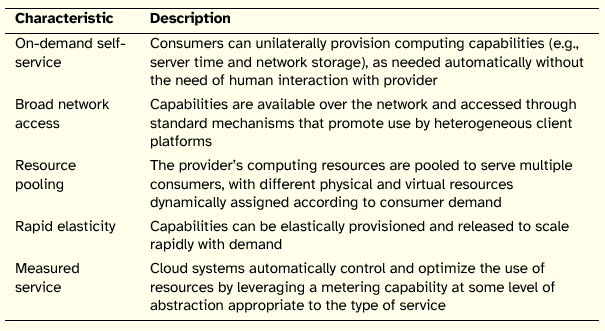
CC are deposits of virtualized IT resources readily usable and accessible, in which the vendor warranties the use and quality of use of those resources to customers and the customers are charged for what they really use [Mell and Grance 2011]. The vendors of CC services provide users with access to IT resources at a lower cost if we consider that customers do not need to acquire and maintain an IT infrastructure. In addition, CC implements a model for enabling ubiquitous, on-demand network access to a shared pool of configurable computing resources that can be rapidly provisioned and released with minimal management effort or service provider interaction [Mell and Grance 2011]. Table 1 lists five essential characteristics of CC.
Table 1: Five Essential Characteristics of Cloud Computing
Adapted from Mell and Grance [2011]
There are various advantages in the adoption of CC. Gutierrez and Lumsden [2014] highlight the following three main benefits of CC. The most frequent benefit relates to cost reduction, such as the removal of IT infrastructure in the organization along with its direct and indirect costs. Resource rationalization is another advantage since the service is dynamically scalable because users only consume the computing resources they actually use. Portability is another advantage as the feature can be accessed not only from any computer connected to the internet, but also from any type of device, such as mobile phones, tablets, laptops, or desktop computers, and from any geographical location.
The focus of this study is on Public Clouds, the most common type of CC available to individual customers and run by third parties. The option for Public Clouds results from the belief that in this model of deployment, the exploration of IT resources can achieve higher levels of optimization at lower costs.
Companies that wish to move their IT services to a Public Cloud face several challenges. The uncertainties about the challenges and issues involved in this technology have been reasons for not accepting Cloud technology as a reliable solution by many organizations [Conway and Curry 2010]. Indeed, the migration to CC does not present a clear path: adopting CC without proper assessment and analysis may in itself become a major risk. The lack of criteria to support IT managers’ decision-making can cause uncertainties and create obstacles to the adoption of this technology [Duarte and Silva 2013]. Prompted by this gap in the knowledge about CC, we conducted an extensive review of the literature in order to compile issues that point to important aspects to be observed by organizations when considering the migration of their technological structure to CC, specifically on Public Clouds. The issues were condensed in a list organized into five main categories as depicted in Table 2.
Table 2: Issues in the Cloud adoption
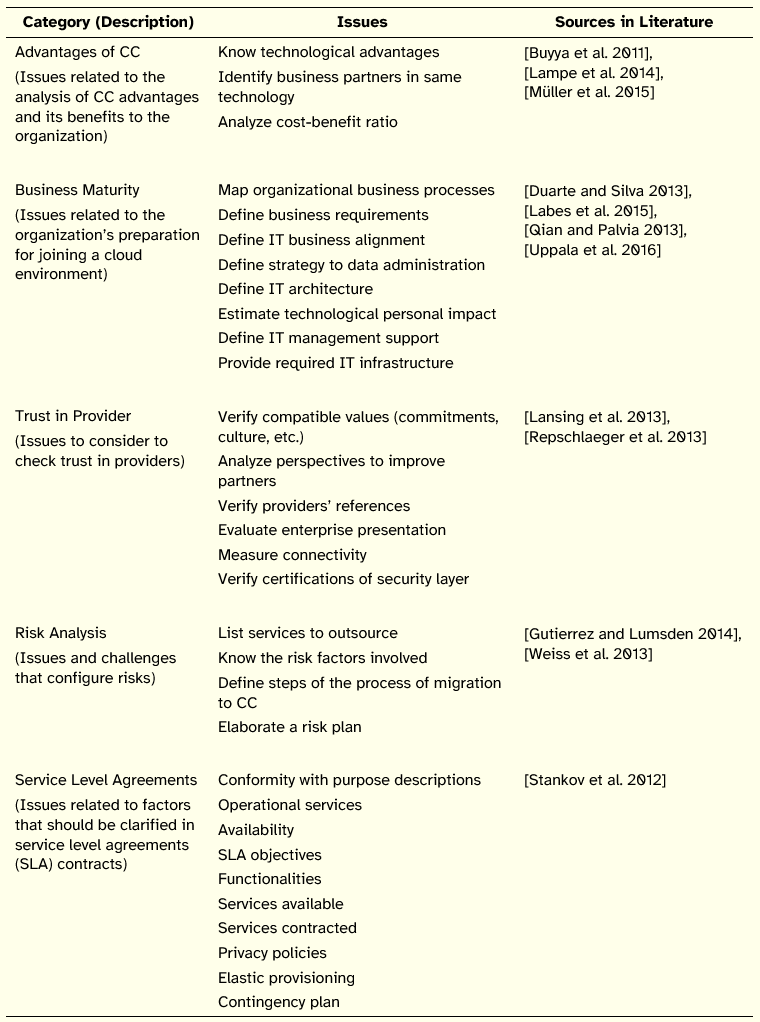
The list of issues suggests that the process of migration to CC is a task that should be well planned and conducted in order for the successful deployment of CC by an organization. Furthermore, the richness of the literature led to the compilation of a list composed of a multiplicity of issues, of different nature and apparently similar importance, which demand competent management by organizations. Although we think that this list of issues is, by itself, a useful resource for assisting IT managers steering the organization towards the adoption of CC, we advocate taking a further step, namely submitting the list to the scrutiny of professionals that undertook a successful migration to CC. The practical view held by such individuals would contribute to a better understanding of the issues in context. On the one hand, it could elucidate whether the list captures the perspective of the practitioners. On the other hand, it could provide indications on the relative importance of each issue, unveiling some order of priority between them, with certain issues being more important than others in the process of adopting CC.
3. Interviews
In order to obtain the views of the practitioners on the list of issues, interviews were conducted with experts of IT Cloud enterprises that migrated to cloud and that provide SaaS (Software as a Service) services to their customers. The professionals interviewed were technical directors of enterprises that have experienced the decision process of adopting CC in their companies and that actively participated in its implementation.
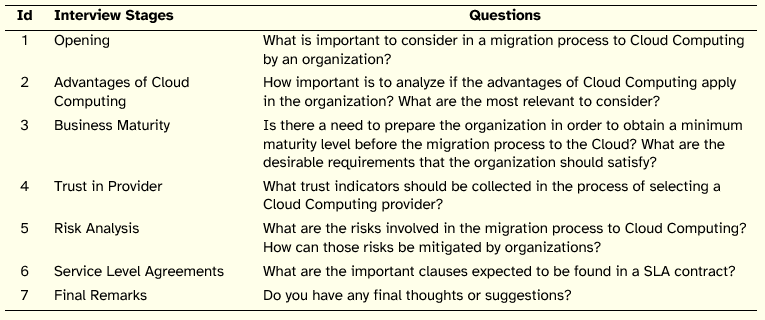
To direct the conversation, an interview guide composed of seven groups of questions was prepared, according to the recommendations of Myers and Newman [2007]. The structure of the guide is described in Table 3. The first stage of the interview prompted a general, unrestricted answer from the interviewee on the relevant issues in the migration process to Cloud. Stages 2 to 6 of the interview (cf. Table 3) focused the conversation on the categories in which the issues compiled during the literature review were organized. The final stage of the interview included an open question so that the respondent could add something he/she judged relevant on the subject addressed and considering the dialogue constructed throughout the conversation.
Table 3: Interview Questions
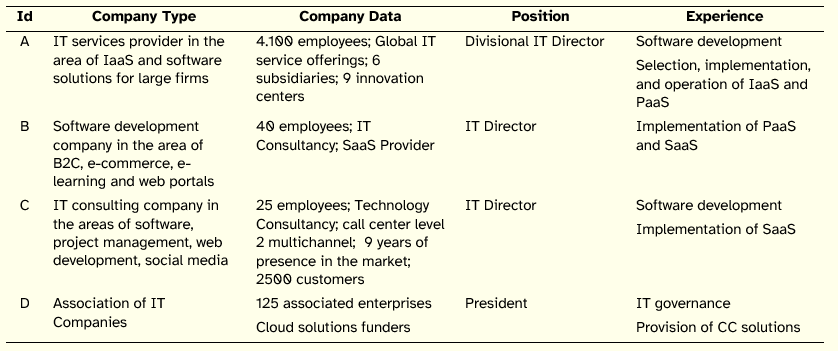
The experts that could participate in the interviews were based in Salamanca, Spain, and were contacted by telephone. Seven directors of IT enterprises were invited, four of these accepted to grant an interview for this research. The process of selecting the pool of respondents was supported by a previous survey of potential experts to be interviewed. The survey included four questions about the characteristics of their organizations (type of company and company data, such as number of employees, structure, etc.) and the experts (position and experience). The main features of the respondents are shown in Table 4.
Table 4: Characterization of Interviewees
Methodologically, semi-structured interviews were used to capture the experts’ opinions. Interview A took 90 minutes, B 65 minutes; C 85 minutes, and D 60 minutes. Respondents were informed about anonymity of participation and were asked permission for the interviews to be audio recorded (all interviewees granted permission).
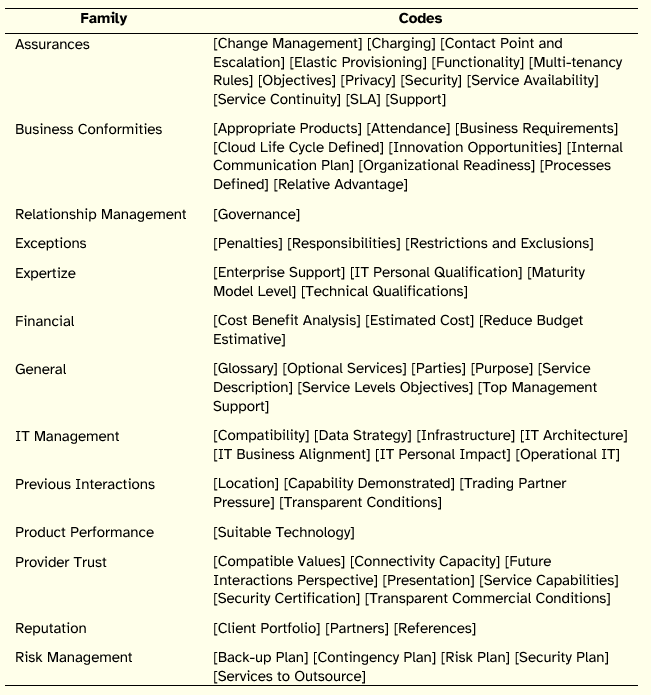
The interviews were then transcribed and coded following a mode of analysis based on grounded theory. In the first step of the coding process, 67 codes were created. Subsequently, the codes were organized into 13 families of common subjects, as shown in Table 5. These families of codes helped us to clarify and contrast the respondents’ contributions and to relate back their views to the five categories of CC issues derived from the literature review.
Table 5: Codes in Interview Analysis
4. Findings
Table 6: Findings in Interviews
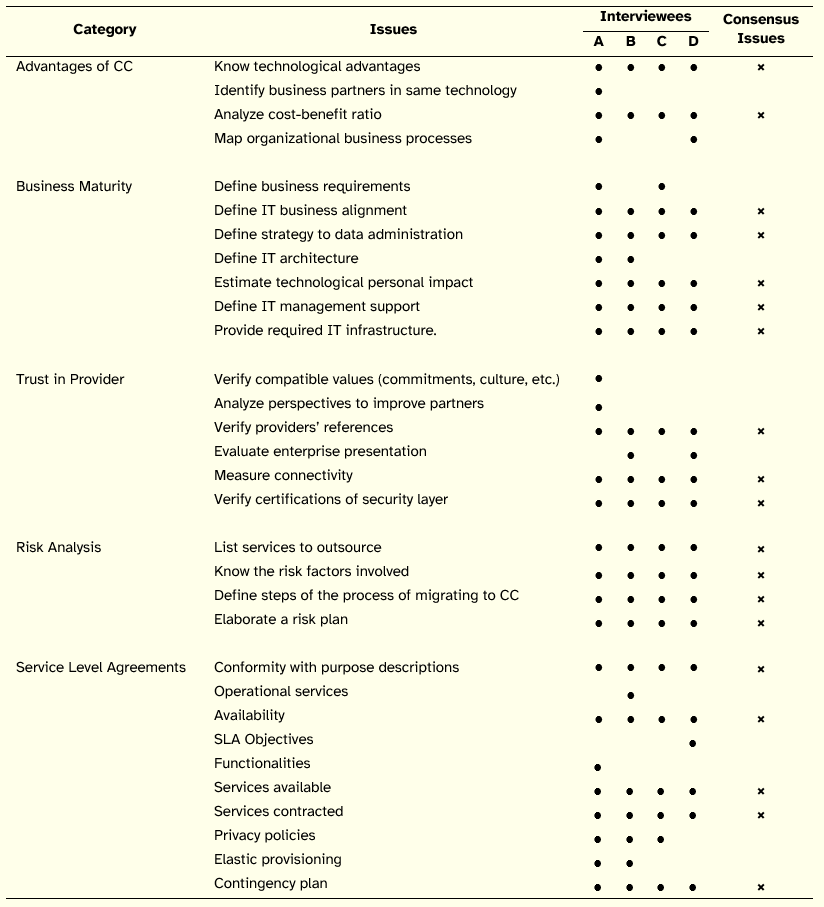
The interviewees confirmed all the categories in which the compiled issues were organized into and provided relevant information that clarify the role of each issue.
5. Discussion
Through the collection of the views of professionals that had been engaged in the migration process to CC, this study aimed to clarify if the list of issues compiled from the literature review conveys the perspective of potential cloud platform customers. The analysis of the data collected in the interviews confirms an important premise about the adoption of CC already suggested in the literature review: when adopting CC services, organizations should analyse the risks involved, the benefits and the advantages of CC, adjust their preparedness (maturity) level, choose the CC provider carefully, and prepare a contract that safeguards their interests.
The results of this study also reveal that the list of issues compiled by the authors reflects the concerns of the experts interviewed. Table 7 lists these most relevant issue’s categories in order of consensus average (number of consensual issues divided by the total number of issues proposed in the category).
Table 7: Most Important Issues Category
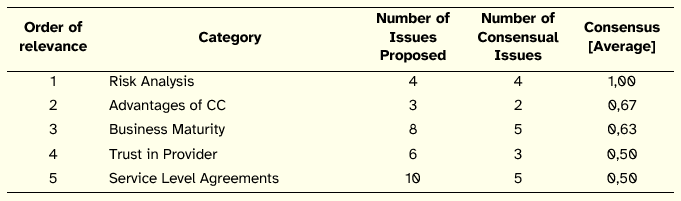
The professionals also contributed with relevant clarifications about those issues through the testimony based on their experience. We also took advantage of the opportunity provided by the interviews to find out if experts considered some order of importance among the categories of issues, i.e., if some categories include more relevant issues and thus deserve more attention by IT managers in comparison to others. According to the interviewees, there are indeed different levels of importance that must be assigned to the categories of issues, as suggested by Table 7.
To some extent, this may be conceptualized as a set of critical success factors for the adoption of CC. Although all categories of issues are relevant for the adoption of CC, there is a group of issues that attract a higher level of concern of practitioners and that have a stronger impact on the path to a successful implementation of CC services by organizations. Indeed, the consensual issues may form the core issues that every organization should take into consideration, in each of the five major categories of issues. For those issues which the analysis of the interviews’ contributions did not suggest an equal important concern among the responds, managers conducting a CC adoption decision process should consider them as contextual. These contextual issues may be more relevant to certain organizations than to others.
6. Limitations and Directions for Future Studies
Some of the limitations of this study derive from its research in progress nature: the work was restricted to the region of Castilla y Leon, Spain, and so far we have just interviewed four experts of IT enterprises, although with substantial experience in CC matters.
To further test, and eventually generalize, the (working) conclusions advanced in this paper, we intend to conduct interviews with respondents whose organizations operate in different settings, such as in different countries, regions, or markets. An important goal of these future studies is to check if the tentative set of critical factors for the successful adoption of CC holds for a broad base of organizations.
A subsequent future work will be the development of an instrument to assist IT managers evaluating the key issues that influence the migration process to Cloud by organizations. The existence of a set of critical success factors with a direct impact on the adoption of CC may substantially increase the effectiveness of that instrument.
Acknowledgment
This work has been supported by COMPETE: POCI-01-0145-FEDER-007043 and FCT–Fundação para a Ciência e Tecnologia within the Project Scope: UID/CEC/00319/2013.
References
AETICAL (2015). Más de 1M€ En Soluciones Cloud Para Castilla Y León. http://www.aetical.com/mas-de-1me-en-soluciones-cloud-para-castilla-y-leon/
Buyya, R., J. Broberg and A. Goscinski (2011). Cloud Computing: Principles and Paradigms. John Wiley and Sons.
Conway, G. and E. Curry (2010). Managing Cloud Computing: A Life Cycle Approach. Proceedings of the 2nd International Conference on Cloud Computing and Services Science CLOSER 2012, 198–207.
Dekker, M. A. C. and D. Liveri (2015). Cloud Security Guide for SMEs. ENISA–European Agency for Network and Information Security.
Duarte, A. and M. M. Silva (2013). Cloud Maturity Model. IEEE International Conference on Cloud Computing, 606–613.
Gutierrez, A. and R. Lumsden (2014). Key Management Determinants for Cloud Computing Adoption. Proceedings of the UK Academy for Information Systems Conference 2014, Paper 43.
Labes, S., N. Hanner and R. Zarnekow (2015). Success Factors of Cloud Business Models. Proceedings of the European Conference on Information Systems—ECIS 2015, Paper 114.
Lampe, U., R. Hans, M. Seliger, M. Pauly and M. Schiefer (2014). Pricing in Infrastructure Clouds–An Analytical and Empirical Examination. Proceedings of the 20th Americas Conference on Information Systems.
Lansing, J., S. Schneider and A. Sunyaev (2013). Cloud Service Certifications: Measuring Consumers’ Preferences for Assurances. Proceedings of the European Conference on Information Systems—ECIS 2013, Paper 181.
Mell, P. and T. Grance. (2011). The NIST Definition of Cloud Computing—NIST SP 800-145. NIST—National Institute of Standards and Technology, U.S. Department of Commerce.
Müller, S. D., S. R. Holm and J. Søndergaard (2015). Benefits of Cloud Computing: Literature Review in a Maturity Model Perspective. Communications of the Association for Information Systems 37, 851–878.
Myers, M. D. and M. Newman (2007). The qualitative interview in IS research: Examining the craft. Information and Organization 17(1), 2–26.
Qian, R. and P. Palvia (2013). Towards An Understanding of Cloud Computing’s Impact on Organizational IT Strategy. Journal of Information Technology Case and Application Research 15(4), 34–54.
Repschlaeger, J., S. Wind, R. Zarnekow and K. Turowski (2013). Decision Model for Selecting a Cloud Provider: A study of Service Model Decision Priorities. Proceedings of the 19th Americas Conference on Information Systems—AMCIS 2013.
Stankov, I., R. Datsenka and K. Kurbel (2012). Service Level Agreement as an Instrument to Enhance Trust in Cloud Computing—An Analysis of Infrastructure-as-a-Service Providers. Proceedings of the 18th Americas Conference on Information Systems—AMCIS 2012.
Uppala, V., R. Bedeley and W. Wang (2016). Managing the Implementation of Cloud Based Technologies : Role of Competing Organizational Objectives. Proceedings of the 22nd Americas Conference on Information Systems—AMCIS 2016.
Weiss, D., J. Repschläger, R. Zarnekow and H. Schrödl (2013). Towards a Consumer Cloud Computing Maturity Model—Proposition of Development Guidelines, Maturity Domains and Maturity Levels. Proceedings of the Pacific-Asian Conference on Information Systems—PACIS 2013, Paper 211.